
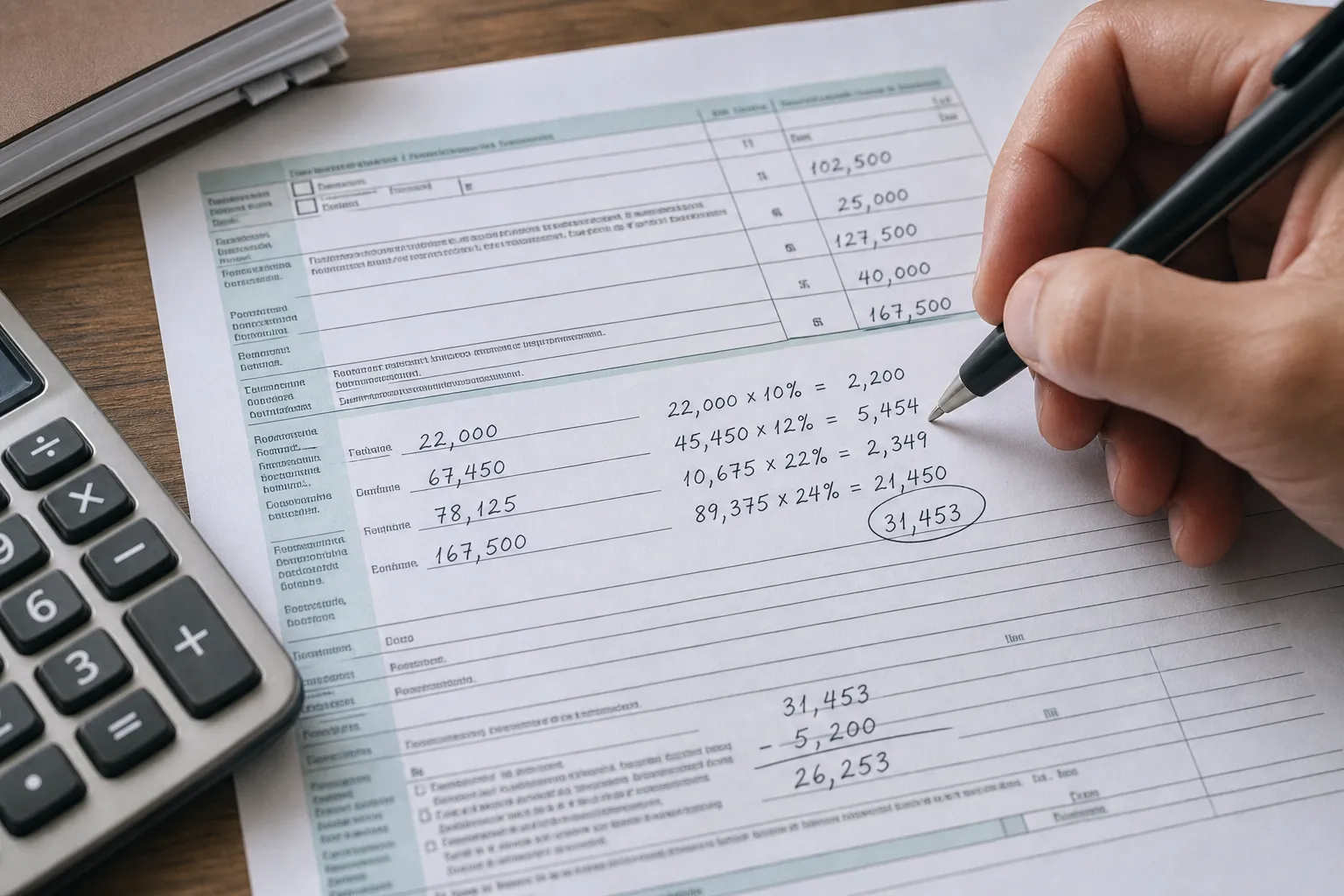
A Roth conversion moves pre-tax money from a traditional IRA or similar account into a Roth account, and the IRS treats the amount you convert as ordinary income in the year you do it. That means the year of the conversion is the year the tax bill lands, and the size of that bill depends on your bracket, your other income, and a few rules most people never see coming. Here is exactly how a conversion hits your return, and how to keep the damage under control.
Key takeaways
-
The full pre-tax amount you convert is added to your taxable income for that calendar year and taxed at your ordinary income rate, not the lower long-term capital gains rate.
-
Conversions carry no automatic tax withholding, so you may need to make estimated tax payments to the IRS to avoid an underpayment penalty.
-
A large conversion can make more of your Social Security benefits taxable and can raise your Medicare premiums through IRMAA surcharges about two years later.
-
You must complete the conversion by December 31 for it to count on that year’s tax return.
Does a Roth conversion count as taxable income the year you do it?
Yes. Every pre-tax dollar you convert is reported as ordinary income for the calendar year the conversion happens. According to Fidelity, the converted amount is taxed at your ordinary income tax rate, the same rate that applies to a paycheck or a traditional IRA withdrawal.
This trips people up because the money inside the IRA may be invested in stocks that have grown for years. You might expect those gains to be taxed at the friendlier long-term capital gains rate. They are not. Inside a traditional IRA, growth was never taxed on the way in, so the IRS collects on the way out at your regular rate.
The one exception involves nondeductible contributions. If you ever put after-tax money into a traditional IRA, that portion is not taxed again when you convert. Only the pre-tax dollars are taxable. Tracking this correctly matters, and it leads straight into a rule that surprises a lot of people.
How much tax will you owe on a Roth conversion?
You owe tax at your marginal bracket on the taxable portion of the conversion, and a large conversion can push part of that income into a higher bracket. This is the single most important number to model before you convert a dime.
Say you are a retired couple with $60,000 of taxable income sitting near the top of a lower bracket. Convert $100,000 and you have not simply added tax at your old rate. The top slice of that conversion may spill into the next bracket, and possibly the one above it. The conversion is taxed in layers, filling your current bracket first, then climbing.
This is why I often tell the retirees I work with to convert in measured amounts rather than one big lump. A common approach is to convert only enough to “fill up” your current bracket without tipping into the next one, then repeat the process over several years. Whether that fits your situation depends on your income, your future required withdrawals, and where you think tax rates are heading. For a deeper look at the choice itself, see our guide on IRA vs. Roth IRA for those 50 and older.
What is the pro-rata rule and how does it affect your conversion?
The pro-rata rule forces you to treat all your traditional, SEP, and SIMPLE IRAs as one combined pool when you figure the taxable share of a conversion. You cannot cherry-pick and convert only your after-tax dollars while leaving the pre-tax dollars behind.
Here is how it works in practice. Suppose your IRAs total $200,000, and $20,000 of that came from nondeductible (after-tax) contributions. That means 10% of your balance is after-tax. Convert $50,000 and the IRS treats only 10% of it, or $5,000, as tax-free. The other $45,000 is taxable, no matter which account you actually pulled from.
People who plan a “backdoor Roth” get caught by this constantly, because they forget the big pre-tax IRA sitting in the background. If you have both pre-tax and after-tax IRA money, run the math before you convert. This is one of those details where a small planning error becomes a real tax bill.
How do you pay the tax on a Roth conversion?
There is no required tax withholding on a Roth conversion, so you are responsible for getting the money to the IRS yourself. You generally have three ways to do it: have your custodian withhold tax from the conversion, make quarterly estimated tax payments, or increase the withholding on other income like a paycheck or pension.
Each choice has a trade-off. When a custodian withholds, the default is often 10%, which may be more or less than you actually owe. Worse, if the withheld tax comes out of the IRA itself and you are under 59½, that withheld portion can count as an early distribution and trigger a penalty.
Paying the conversion tax from money outside the IRA is almost always the stronger move, and here is why: every dollar you leave inside the Roth keeps growing tax-free for the rest of your life. Pay the tax with taxable-account cash, and your entire conversion goes to work in the Roth. Pay it out of the IRA, and you shrink the very asset you were trying to build. If you owe a large amount, plan estimated payments across the year so you do not face an underpayment penalty at filing time.
What ripple effects can a Roth conversion trigger?
A conversion raises your income for the year, and that higher income can quietly increase costs that have nothing to do with your tax bracket. Two effects catch retirees most often.
First, more of your Social Security may become taxable. Social Security taxation is based on a measure of income that includes your conversion, so a big conversion can push a larger share of your benefits into the taxable column.
Second, your Medicare premiums may rise through the Income-Related Monthly Adjustment Amount, known as IRMAA. Medicare looks back two years to set your premiums, so a large conversion this year can raise your Part B and Part D premiums two years later, sometimes by a meaningful amount. Timing conversions before you start Medicare, or keeping each year’s income below the next IRMAA threshold, can matter as much as the bracket itself.
State income tax is the third effect. Most states with an income tax follow the federal rules and tax the conversion as ordinary state income in the year you do it. In California, for example, the conversion is taxed at your state rate on top of the federal bill, which is why high earners here often stage conversions carefully. Physicians and other high-income professionals face a sharper version of this math, covered in our guide on IRA options for California medical doctors.
When is the best year to do a Roth conversion?
The best conversion years are usually your lowest-income years, because that is when the conversion is taxed at the lowest rate. As the owner’s own tax planning notes put it, conversions are most advantageous in lower-than-average income years and low tax bracket years, and particularly useful if you expect to be in a higher bracket later.
Ranked by how often they create an opening, the windows I watch for are:
-
The gap years between retirement and age 73. Once your paycheck stops but before required minimum distributions (RMDs) begin, your income often dips. Converting during this window can shrink future RMDs and the taxes they create.
-
A year of unusually low income. A business loss, a sabbatical, or a down market that temporarily depresses your other income can open room to convert cheaply.
-
Before you claim Social Security. Converting first, then claiming, can keep your conversion from making your benefits taxable.
You can also soften the tax hit by pairing a conversion with offsetting moves in the same year, such as tax-loss harvesting or, if you are over 70½ and give to charity, a qualified charitable distribution. These are exactly the kinds of items that belong on a written Tax One Page Plan so short-term, intermediate-term, and lifetime tax strategy all point the same direction.
One more reason people convert has nothing to do with their own retirement. A Roth passes to heirs income-tax-free, which can be a lasting gift, a theme we explore in planning for your children’s retirement.
If you want the conversion tax modeled against your actual brackets, IRMAA thresholds, and Social Security, that is what our Complimentary Tax Analysis is built to show. Call 916-325-0130 and our team will reach out the next business day.
Frequently asked questions
how does a roth conversion affect my taxes in the year i do it?
The pre-tax amount you convert is added to your taxable income for that calendar year and taxed at your ordinary income rate. A large conversion can push part of that income into a higher bracket, make more of your Social Security taxable, and raise your Medicare premiums two years later. There is no automatic withholding, so you may owe estimated tax payments to avoid a penalty.
are roth conversions taxed as capital gains or ordinary income?
Roth conversions are taxed as ordinary income, not as capital gains. Even if your traditional IRA holds appreciated stocks, according to Fidelity the converted amount is taxed at your ordinary income tax rate, the same rate that applies to wages or a pension. Only after-tax (nondeductible) contributions escape this tax.
what is the deadline to do a roth conversion for this tax year?
The conversion must be completed by December 31 to count on that year’s return. As TaxAct notes, unlike IRA contributions, a conversion cannot be done in the following year and applied backward. Give your custodian enough lead time before year-end so the transfer settles on time.
do i have to pay taxes right away on a roth conversion?
You do not pay at the moment of conversion, but the tax is due for that tax year, and there is no required withholding. Because the IRS expects tax to be paid as income is earned, you may need to make a quarterly estimated payment or increase other withholding to avoid an underpayment penalty at filing time. Paying the tax from money outside the IRA keeps your full conversion growing tax-free.
can a roth conversion increase my medicare premiums?
Yes. Medicare uses your income from two years earlier to set premiums, so a large conversion can raise your Part B and Part D premiums through IRMAA surcharges about two years down the road. Staging conversions to stay under the next IRMAA threshold, or converting before you enroll in Medicare, can help you avoid the surcharge.

WE Alliance Wealth Advisors
Latest posts by WE Alliance Wealth Advisors (see all)
- Roth Conversion Tax Bill: What You Owe in Year One - September 17, 2026

 3001 Douglas Blvd, Suite 142
Roseville,
CA 95661
3001 Douglas Blvd, Suite 142
Roseville,
CA 95661